

Glass silk-screen printing is actually a processing sequence of glass. In daily life, we find that many glasses actually have some patterns or designs, and some of these patterns are silk-screen printed. To complete this process, it is necessary to go to a specific place and have special masters hand-paint them on. Therefore, the production process is also very exquisite. The price is also relatively higher.
The principle of screen printing
As the name suggests, it actually prints ink onto the surface of flat glass. Then, I will have a special curing measure for the ink. This measure will make the humor more durable and the pattern last longer. First, you need to set up the stretching net and apply the slurry in sequence. After the first drying, the plate needs to be exposed to the sun. Once it is dry, you will find that the painted patterns will be revealed. After that, it also needs to be dried again.
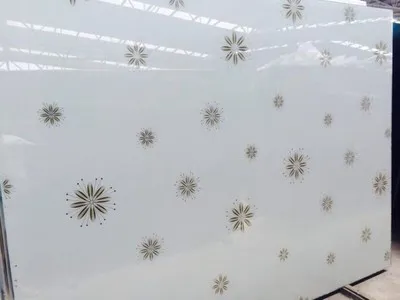
If it is flat glass, after all these steps are completed, it needs to be cut to the appropriate size, and the four sides should be ground relatively flat before cleaning, drying and printing. All in all, this process seems simple, but it is actually very complicated to carry out.
Product application

In our daily life, it is a kind of glass and is also widely used, for example, on the panel of an advertising machine. Stone tool panels or speaker panels, and so on, many electrical appliances have this kind of glass. Or when we go to some places selling lighting fixtures, we can see many beautiful lighting fixtures with this kind of glass. Not only that, it can also be found on small pendants like clocks.
Screen printing technology uses a screen as the base plate and, through photosensitive plate-making methods, creates a screen printing plate with graphics and text.
Screen printing consists of five major elements: the screen printing plate, the squeegee, the ink, the printing table and the substrate. Printing is carried out based on the fundamental principle that the mesh holes in the image and text parts of the screen printing plate can pass through the ink, while those in the non-image and text parts cannot. When printing, ink is poured into one end of the screen printing plate. A scraper is used to apply a certain pressure to the ink area on the screen printing plate, and at the same time, it moves uniformly towards the other end of the screen printing plate. During the movement, the ink is squeezed from the mesh holes of the graphic part by the scraper onto the substrate.


