

The flatness of tempered glass is inferior to that of float glass. It requires thicker films to fill and buffer the minor deformations caused by the tempering process, thereby ensuring the safety and optical performance after lamination.
1. Differences in the inherent properties of glass
Float glass
High surface flatness: During the production process of float glass, the glass liquid floats on the molten tin liquid, forming a very flat and smooth surface.
Shape stability: Its surface can be regarded as a nearly ideal plane.
There is a "wavy shape" or "bow shape" : The tempering process involves heating the glass to a temperature close to its softening point and then rapidly and evenly cooling it. During this process, the cooling rates inside and outside the glass are inconsistent, resulting in permanent internal stress. This will cause tiny, hard-to-detect bends or ripples on the glass surface, which is known as "waviness".
Non-reprocessable: Once tempered glass is made, it cannot be cut, drilled or edge-ground as its shape is fixed.
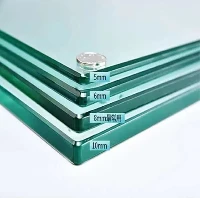
2. Requirements for film in laminated process
Laminated glass is made by firmly bonding multiple layers of glass and the film in between (usually PVB or SGP, etc.) through high temperature and high pressure. This process requires that the film be able to:
Complete gap filling: The film must flow under high pressure to fill all the tiny gaps between the two pieces of glass, expel air, and achieve 100% adhesion. Any gap will become the starting point of delamination, affecting safety and appearance.
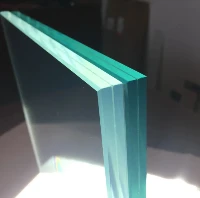
Stress absorption: When laminated glass is subjected to external force impacts (such as being hit by stones) or temperature changes, the glass will undergo slight deformation. The film needs to absorb and disperse these stresses to prevent the glass from breaking or delaminating.
Ensure optical performance: If the film cannot fully fill the gap, air will remain in the middle, forming "bubbles" or "optical distortion", which affects the clarity of the line of sight.
Why does tempered laminated glass need thicker film?
Now let's combine the above two points to look at:
When two flat float glasses are used, the gap between them is very uniform. A standard-thickness film (such as 0.38mm or 0.76mm) is sufficient to easily fill this uniform gap and achieve perfect bonding under high pressure.
When two pieces of tempered glass are used, due to the waviness of each piece of glass, the gap between them is uneven when the two pieces of glass are combined. Some places have large gaps, while others have small ones.
If a film of the same thickness as float glass is used, when pressure is applied, the film may not flow to the area with the smallest gap, resulting in poor adhesion in these areas.
Meanwhile, in the area with the largest gap, the film may be overly stretched and become thinner, even leading to local delamination or optical deformation (distortion of the object).
Therefore, the solution is to use thicker film (for example, from 0.76mm to 1.14mm or 1.52mm).
Thicker films provide more "filling materials", which can better adapt to and compensate for the uneven surface of tempered glass, ensuring uniform and sufficient adhesion throughout the entire glass surface.
A thicker buffer layer can also better absorb the huge energy released when tempered glass breaks (tempered glass breaks into small particles, but the internal stress is released instantly).
Conclusion: The selection of thicker films for tempered laminated glass is mainly to compensate for its inherent flatness defect, ensuring that the laminated products are free of bubbles and optical distortion, and have long-term safety and reliability.


